Interested in technological art, robots, or just creating advanced technology?
Dorkbot is an international organization to explore all uses of technology in the development and discussion of art and creative exercise. This can involve practices ranging from virtual and interactive art to video and audio landscapes. The Dorkbot DC chapter has recently formed, and is growing quickly!
Next Meeting:
Tuesday, August 15, 2006
8PM-10PM
Teaism
400 8th Street NW
Washington, DC 20004
More info at the Dorkbot DC web site.
Friday, August 04, 2006


Tuesday, August 01, 2006
Long Distance Internet Touch
Here is video of differential pressure touch between two fingers. The two RVHEs send packets with pressure info to a server 60 miles away, then the server calculates the finger positions and sends that back. A "helper" PC is in the middle to serve as a gateway between the RVHE LAN and the outside Internet.
Obviously some scaling and timing issues need to be worked out, plus I am going to move the pressure sensors from the fingertips to near where the fingers connect to the servos, but at least there is some hope of things working!
I was able to build a serial cable to connect to the SBC65EC, which makes it much easier to configure. I have greater hopes for this board now.
Looking for a free Windows DHCP server? Try this one from Uwe A. Ruttkamp. Don't ask me why the world isn't full of public domain and open source DHCP servers for Windows. It just isn't.
Obviously some scaling and timing issues need to be worked out, plus I am going to move the pressure sensors from the fingertips to near where the fingers connect to the servos, but at least there is some hope of things working!
I was able to build a serial cable to connect to the SBC65EC, which makes it much easier to configure. I have greater hopes for this board now.
Looking for a free Windows DHCP server? Try this one from Uwe A. Ruttkamp. Don't ask me why the world isn't full of public domain and open source DHCP servers for Windows. It just isn't.
Moving forward with Touch
I got tired of trying to find a solution where the Ethernet-enabled microcontroller boards would exist on their own (due to not putting the router MAC address on UDP packets, or basically being unable to DHCP a router address, depending on board).
So I decided to just bite the bullet and use static IP addresses and a "helper PC" that forwards packets to the Internet server that connects the two ends of Touch together.
So I hooked up an RVHE (the big board on the bottom) to the Pololu Micro Serial Servo Controller (which is the very small board on the left). I'm using the same RS-232 connection that you use to program the RVHE in BASIC to connect to the servo controller, as RVHE.com is now defunct and I can't figure out where the second RS-232 port is on the RVHE from the documentation!
![IMG_0902[1]](http://static.flickr.com/70/203896429_57879481fa.jpg)
So now one finger of pressure sensor info is sent by a second RVHE through the "helper PC" program to the Internet server. The first RVHE also sends its one finger of pressure sensor info through the "helper PC" to the Internet server as well. The Internet server then sends back a finger position to both RVHE's through the "helper PC", and the RVHE's command the servo controller over the RS-232 connection.
This gives me one finger's worth of Touch to test out timing and scaling issues. I think the RVHE is a dead product now, so I imagine it won't make it into the final project. It is too bad, the RVHE was like a BASIC stamp with Ethernet, which would rule.
In other news, I think I might have found a solution to my Modtronix SBC65EC UDP ARP/DHCP problems. We'll see tonight...
So I decided to just bite the bullet and use static IP addresses and a "helper PC" that forwards packets to the Internet server that connects the two ends of Touch together.
So I hooked up an RVHE (the big board on the bottom) to the Pololu Micro Serial Servo Controller (which is the very small board on the left). I'm using the same RS-232 connection that you use to program the RVHE in BASIC to connect to the servo controller, as RVHE.com is now defunct and I can't figure out where the second RS-232 port is on the RVHE from the documentation!
So now one finger of pressure sensor info is sent by a second RVHE through the "helper PC" program to the Internet server. The first RVHE also sends its one finger of pressure sensor info through the "helper PC" to the Internet server as well. The Internet server then sends back a finger position to both RVHE's through the "helper PC", and the RVHE's command the servo controller over the RS-232 connection.
This gives me one finger's worth of Touch to test out timing and scaling issues. I think the RVHE is a dead product now, so I imagine it won't make it into the final project. It is too bad, the RVHE was like a BASIC stamp with Ethernet, which would rule.
In other news, I think I might have found a solution to my Modtronix SBC65EC UDP ARP/DHCP problems. We'll see tonight...
Thursday, July 20, 2006
UDP Pain
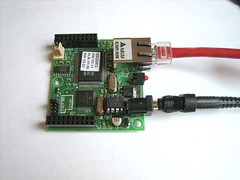
So I went ahead and purchased the Modtronix SBC65EC. Here it is with power and Ethernet:
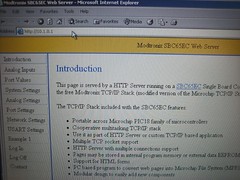
It took a while for me to install all the Microchip development software, but finally it was working and I compiled the Web server for the chip:
So with the stock Web server working, I decided I'd start to work on having the board initiate communications. First I started with a static IP for the board. TCP transmission worked fine. UDP transmission was less promising. It ARPed the destination MAC, but then didn't put the MAC in the Ethernet header of transmitted UDP packets!!!
Well, at least I have the source code and if motivated I can find the bug myself, fix it, and recompile. It also isn't clear to me how/if DHCP works on the board.
Suffice it to say, I'm sick of these almost-IP capable microcontroller boards!
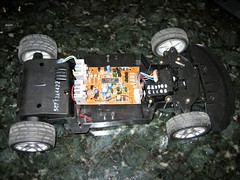
To cheer myself up, I picked up a 9.6V car for Sycophant II:
It took a while for me to install all the Microchip development software, but finally it was working and I compiled the Web server for the chip:
So with the stock Web server working, I decided I'd start to work on having the board initiate communications. First I started with a static IP for the board. TCP transmission worked fine. UDP transmission was less promising. It ARPed the destination MAC, but then didn't put the MAC in the Ethernet header of transmitted UDP packets!!!
Well, at least I have the source code and if motivated I can find the bug myself, fix it, and recompile. It also isn't clear to me how/if DHCP works on the board.
Suffice it to say, I'm sick of these almost-IP capable microcontroller boards!
To cheer myself up, I picked up a 9.6V car for Sycophant II:
Cheap Linear Motion
This article is on building your own CNC machine, but I am interested in the linear actuator part mainly.
Thursday, June 29, 2006
New Boards
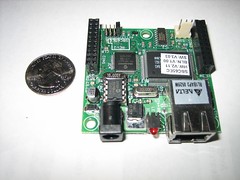
Here is the Modtronix SBC65EC. It is a PIC18F6627 based system with Ethernet, RS232, I2C, 12 Analog Inputs, and 32 Digital I/Os. It comes pre-loaded with Web Based Configuration, and can bootload new programs over Ethernet:
And here is the Pololu Micro Serial Servo Controller. It is an 8-channel servo controller driven with RS-232 or TTL serial. It is small!
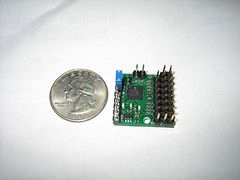
Could I write a 5-channel servo controller on the SBC65EC board? Probably yes, but since the Pololu controller only cost $20, it isn't worth me spending the 10 hours it would take to write the servo controller and make it work well and play nice with the TCP/IP stack. Unfortunately the SBC65EC does not expose all of the PIC18F6627 PWM outputs, so I'd have to do the PWMing myself.
And here is the Pololu Micro Serial Servo Controller. It is an 8-channel servo controller driven with RS-232 or TTL serial. It is small!
Could I write a 5-channel servo controller on the SBC65EC board? Probably yes, but since the Pololu controller only cost $20, it isn't worth me spending the 10 hours it would take to write the servo controller and make it work well and play nice with the TCP/IP stack. Unfortunately the SBC65EC does not expose all of the PIC18F6627 PWM outputs, so I'd have to do the PWMing myself.
Monday, June 26, 2006
Scott Hutchison in Elan Magazine
My friend Scott Hutchison was featured in May's Elan Magazine. The article mentions the work Look that we collaborated on.
Subscribe to:
Posts (Atom)