Wednesday, July 09, 2008

LA Tech Art Events for July

Midnight Thursday July 10th to midnight Friday July 11th
Machine Project (in Echo Park) will be projecting a continuous live broadcast which tracks the sun around the Earth, with help from a very large circle of camera-ready friends and volunteers worldwide. A participant in every time zone points their computer camera to the sky between 11:30am and 12:30pm, with one timezone handing off to the next, feeding back “mid-day” to Machine Project via live video for 24 hours. Have you always been curious what it is like to stare directly at the sun from places like Tonga, Estonia, Texas, Iran or the Polar ice cap in Greenland? This is your chance to find out.


July 17, 2008 8PM 
ResBox @ STEVE ALLEN THEATER at the Center For Inquiry - West, 4773 Hollywood Blvd.

A monthly event featuring the world's best experimental music, curated
by musician and filmmaker Hans Fjellestad.

This month: EZRA BUCHLA, TREASURE MAMMAL, JASON ROBINSON & DJ TENSHUN, KADET KUHNE and the resident audio visualist VJ FADER


July 19 7PM - 7AM 

GLOW on the beach in Santa Monica:

"Glow will fill the hours between dusk to dawn with compelling, enchanting and effervescent sights and sounds situated in spaces and times that expand possibilities for where, how and when the public experiences contemporary art."

Artists will include Usman Haque (who did the 1000 helium balloons with radio controlled LEDs inside for the 2006 Signapore Biennale. Also there will be Shih Chieh Huang who will be creating a "Neptunian lair" along the pedestrian path under the Santa Monica Pier.

Machine Project also says they will be presenting at GLOW as well.


July 26 1PM @ Machine Project

Steven Gentner  will be speaking about a robot project built using RoboRealm, a powerful free computer vision based application for use in machine vision, image analysis, and image processing systems.

Gil Kuno  whose sonic artwork displace natural activity from its context, revealing an otherwise hidden level of metaphorical absurdity within the ordinary patterns present before our eyes.

Brett Doar a "paratechnologist" who creates "idiosyncratic electro-mechanical creatures out of inappropriate materials."

Wednesday, May 28, 2008

Breath Progress

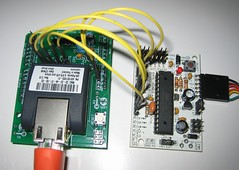
Here is the Arduino BBB connected with the Adafruit Ethernet shield:

Arduino BBB and Ethernet Shield

One important issue if you get the Adafruit Ethernet shield, it will be much more useful if you have an Arduino with an ATmega168, since then it can use the AF SoftSerial library.

You see, the ATmega only has one hardware serial port, and you are generally busy using that to upload programs and monitor Arduino operation during testing.  Lady Ada has put together a software serial library that doesn't suck (unlike the standard Arduino software serial library), but it depends on having an ATmega168 rather than an ATmega8.

If you have an old Arduino (like the NG), you can pick up a pre-programmed ATmega168 from Adafruit to swap for your old ATmega8.

Here is my simplified version of a Lady Ada Xport example, creating a general "httpget" example.  And yes, it works!

#include "AFSoftSerial.h"
#include "AF_XPort.h"
#include
#include

char linebuffer[256];
int lines = 0;

#define XPORT_RXPIN 2
#define XPORT_TXPIN 3
#define XPORT_RESETPIN 4
#define XPORT_DTRPIN 0  // I'm not using DTR
#define XPORT_CTSPIN 6
#define XPORT_RTSPIN 7

AF_XPort xport = AF_XPort(XPORT_RXPIN, XPORT_TXPIN, XPORT_RESETPIN, XPORT_DTRPIN, XPORT_RTSPIN, XPORT_CTSPIN);

uint8_t errno,ret;
uint32_t laststatus = 0, currstatus = 0;

void setup() {

Serial.begin(57600);
xport.begin(9600);
}

void loop()
{


ret = httpget("64.233.183.104",80,"www.google.com","/"); 

if (ret)
Serial.println("get successful");
else
Serial.println("not successful");
delay(10000);
}

uint8_t httpget(char *ipaddr,
int port,
char *hostname,
char *httppath) {
uint8_t ret;
uint8_t success = 0;

ret = xport.reset();
Serial.print("Ret: "); Serial.print(ret, HEX);

switch (ret) {
case ERROR_TIMEDOUT: {
Serial.println("Timed out on reset!");
return 0;
}
case ERROR_BADRESP: {
Serial.println("Bad response on reset!");
return 0;
}
case ERROR_NONE: {
Serial.println("Reset OK!");
break;
}
default:
Serial.println("Unknown error");
return 0;
}


// time to connect...

ret = xport.connect(ipaddr, port);
switch (ret) {
case ERROR_TIMEDOUT: {
Serial.println("Timed out on connect");
return 0;
}
case ERROR_BADRESP: {
Serial.println("Failed to connect");
return 0;
}
case ERROR_NONE: {
Serial.println("Connected..."); break;
}
default:
Serial.println("Unknown error");
return 0;
}

xport.print("GET ");
xport.print(httppath);
xport.println(" HTTP/1.1");
xport.print("Host: "); xport.println(hostname);
xport.println("");

success=0;
while (1) {
// read one line from the xport at a time
ret = xport.readline_timeout(linebuffer, 255, 3000); // 3s timeout
// if we're using flow control, we can actually dump the line at the same time!
Serial.println(linebuffer);
if (strstr(linebuffer, "HTTP/1.1 200 OK") == linebuffer)
success = 1;

if (errno == ERROR_TIMEDOUT)
Serial.println("ERROR_TIMEDOUT");

if (xport.disconnected())
Serial.println("xport.disconnected");

if (((errno == ERROR_TIMEDOUT) && xport.disconnected()) ||
((XPORT_DTRPIN == 0) &&
(linebuffer[0] == 'D') && (linebuffer[1] == 0))) {
Serial.println("\nDisconnected...");
return success;
}
}
}


Sunday, May 11, 2008

BBB for Breath-to-Breath

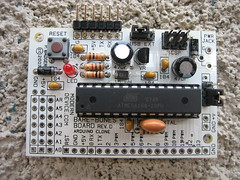
I am working on a breath-to-breath phy2phy project. I already had one Arduino NG around, so I purchased an Adafruit Ethernet Shield, and also a Modern Device Bare-Bones Board Arduino clone with a USB-to-TTL serial cable.

"Arduino" Bare-Bones Board

The BBB board had a couple of holes that were still filled with solder, so I had to solder wick them and then heat up a little piece of lead snipped from a resistor and used the soldering iron to heat up the lead and push through the solder-filled holes to open them up.

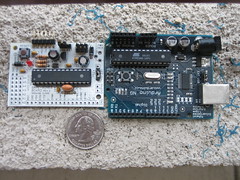
BBB versus Arduino


Just to be clear, standard Arduino shields do not fit on the Bare-Bones Board (so I probably should have purchased a Really Bare-Bones Board), but you can always hook it up with wires.

I am developing for the Arduino and BBB on a MacBook using the USB to TTL serial cable fro FDTI. Make sure you follow the OS X instructions on how to install the FDTI drivers. These will allow you to use either a USB cable to a Arduino or the FDTI USB to TTL cable for the BBB/RBBB. Also make sure you choose the correct ATMEGA chip from the Arduino software menu. And since there isn't much indication that the BBB works (unlike the flashing LEDs on the Arduino), so try a serial example on the BBB to convince yourself that you are uploading and running a program.

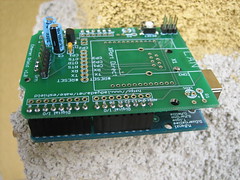
Here is the Ethernet shield on an Arduino NG:

Xport Shield on Arduino

I am awaiting two Xport directs in the post, then I can really get to business.

Tuesday, April 08, 2008

2,300 mile touch over IP

On Saturday, I guest hosted & presented at Dorkbot SoCal.  Along with Damon Seeley who showed off some super projects by Electroland (including live video from their Target Breezeway in Rockefeller Center), Gilad Lotan who showed some of his projects including the heartbeat-sharing imPulse, and a discussion of the Make:Way entry to the 24 Hours of LeMons race, I demoed touching someone 2,300 miles away over IP. Douglas Welch shot and edited this great video of the demo:


Thursday, January 31, 2008

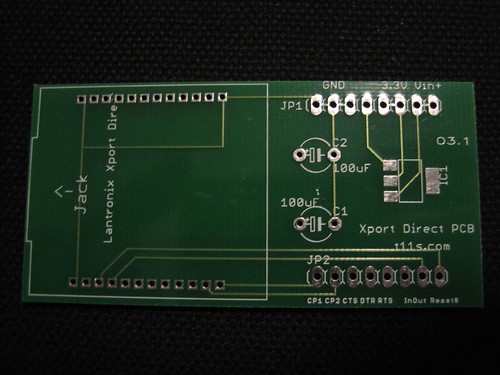
First "real" PCB

Back in high school, I made some PCBs using resist pens and etching the copper, but nothing very serious.

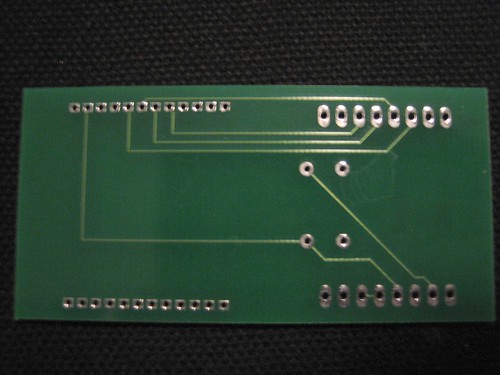
I decided it was finally time to try using the free Eagle design tool along with BatchPCB.com service to make a PCB. My issue was that the wonderfully cheap Lantronix Xport Direct uses 0.2mm spaced pins which are a pain to interface to. So I figured this would be a good opportunity to design a PCB with a 3.3V power supply and the Xport broken out to 0.1" spaced standard headers.


pcb_design

Xport PCB

Xport PCB

The boards took about 3 weeks from submission to delivery (which was over New Year's so it might be faster for you), and cost $24.60. For that price you get two boards (this was a 3.8 sq. inch design).

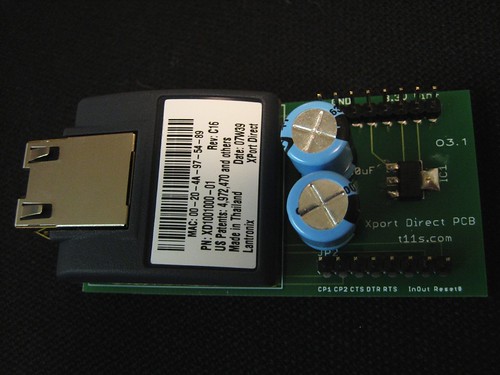
my_populated_board


So I populated the board and hooked everything up, and it appeared to work fine...until I started smelling something burning. I powered down, and after a short reference of the LM1117 documentation, I realized even though the regulator is only providing 200mA to the Xport, with a 9V supply the regulator needs to dissipate ~1.2W, which multiplied by the thermal resistance of the SOT-223 to ambient of 136 degrees C per Watt, means the regulator is warming up 163C above room temp, about 183C. OK, that is a little hot!

Max junction temperature is 125C, so if room temp is 20C, I can get by with 100C rise which for 1.2W implies a heatsink with a thermal resistance of ~80C/W, which means 0.3-0.5 sq. inch of heatsink (two wings larger than the size of the actual chip). Anyway, next time I'm doing at least a TO-252 or just go TO-220 with the ability to add an external heatsink if needed.

For the short term, I think I can jury-rig an external heatsink, but the lesson has been learned for my next design: an Ethernet-enabled Freeduino.

Here is a link to my Eagle library for the Lantronix Xport Direct.

If you need a PC fast in LA...

Here is my suggestion if you need a PC fast in LA:

PC Club

Sunday, December 02, 2007

Move and SymbioticA

I recently moved to Los Angeles, so last night I hit Machine Project to go see Oron Catts & IonatZurr of SymbioticA speak about tissue culture art. Definitely cool stuff!

iTunesU has a neat video about creating art-games, go to the iTunes store and search for
"joe mckay finding balance".

More info here:

http://hci.stanford.edu/cs547/abstracts/06-07/061006-niemeyer.html

You can also check out Joe McKay's website.